

Stripe login and payment flow
This guide describes how a logged-in end user completes a Stripe purchase when your client uses the Vimond Default Payment Provider. It complements the platform Payment guide (product groups and orders on the Vimond REST API) by focusing on the payment-provider service and Stripe.js. For the Vipps redirect-based flow, see Vipps login and payment flow.
Typical components:
| Role | Responsibility |
|---|---|
| Client app | Login (OIDC/JWT), checkout UI, Stripe Elements, confirmCardPayment |
| Default Payment Provider | Customer/payment-method APIs, checkout, webhook verification, agreements and charges |
| Stripe | Payment methods, subscriptions, payment intents, webhooks |
API contracts: Default Payment Provider — Stripe Checkout, Stripe Webhooks, Customer · compact OpenAPI index
Prerequisites: End-user authentication. For subscription concepts after purchase, see SVOD.
Simplified flow (high-level)
Section titled “Simplified flow (high-level)”
What happens in plain language
Section titled “What happens in plain language”- User logs in in the web app and gets a JWT.
- Web app fetches saved payment methods from backend.
- User checks out with Stripe card flow.
- Backend creates Stripe subscription/payment intent and returns
clientSecret. - Frontend confirms payment with Stripe (
confirmCardPayment). - Stripe sends webhooks to backend.
- Backend updates agreements, charges, and entitlements.
Sequence flow (implementation-oriented)
Section titled “Sequence flow (implementation-oriented)”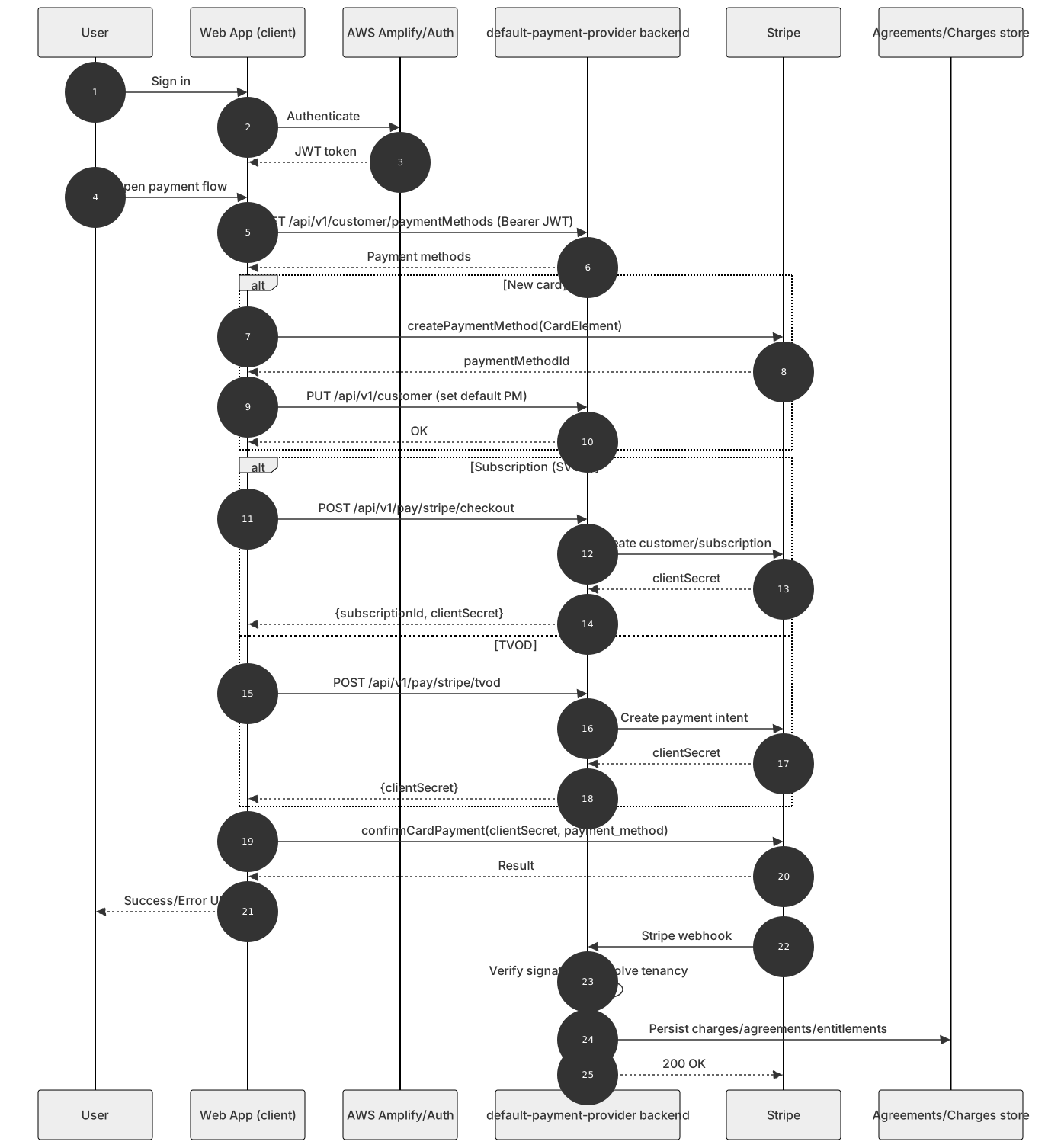
Note: The client confirms payment for UX; webhooks finalize agreement and charge records. Do not treat a successful
confirmCardPaymentalone as subscription activation.
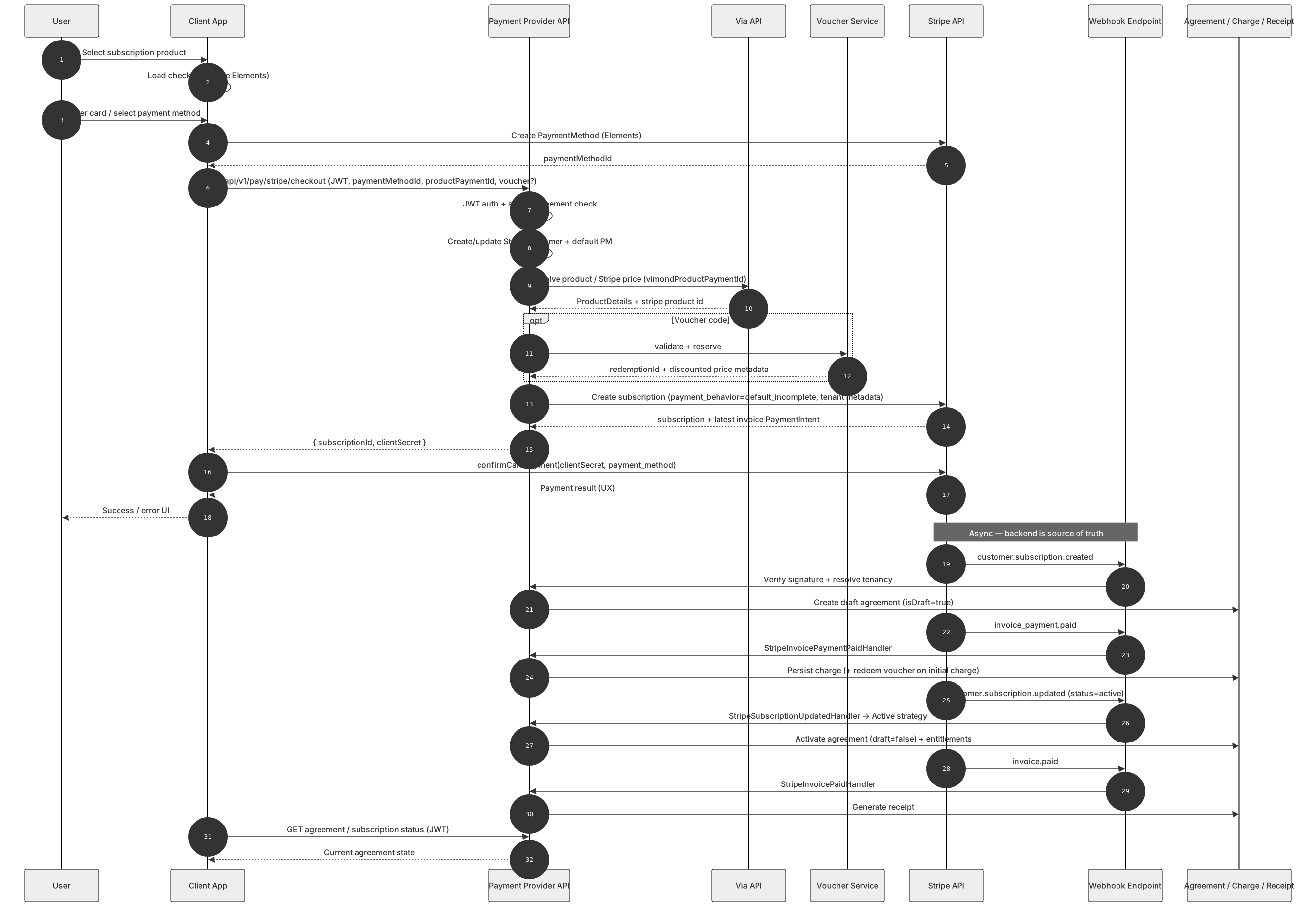
Stripe SVOD sequence (detailed)
Section titled “Stripe SVOD sequence (detailed)”Client confirms payment; durable state is driven by webhooks.
Stripe SVOD sequence (swim lanes)
Section titled “Stripe SVOD sequence (swim lanes)”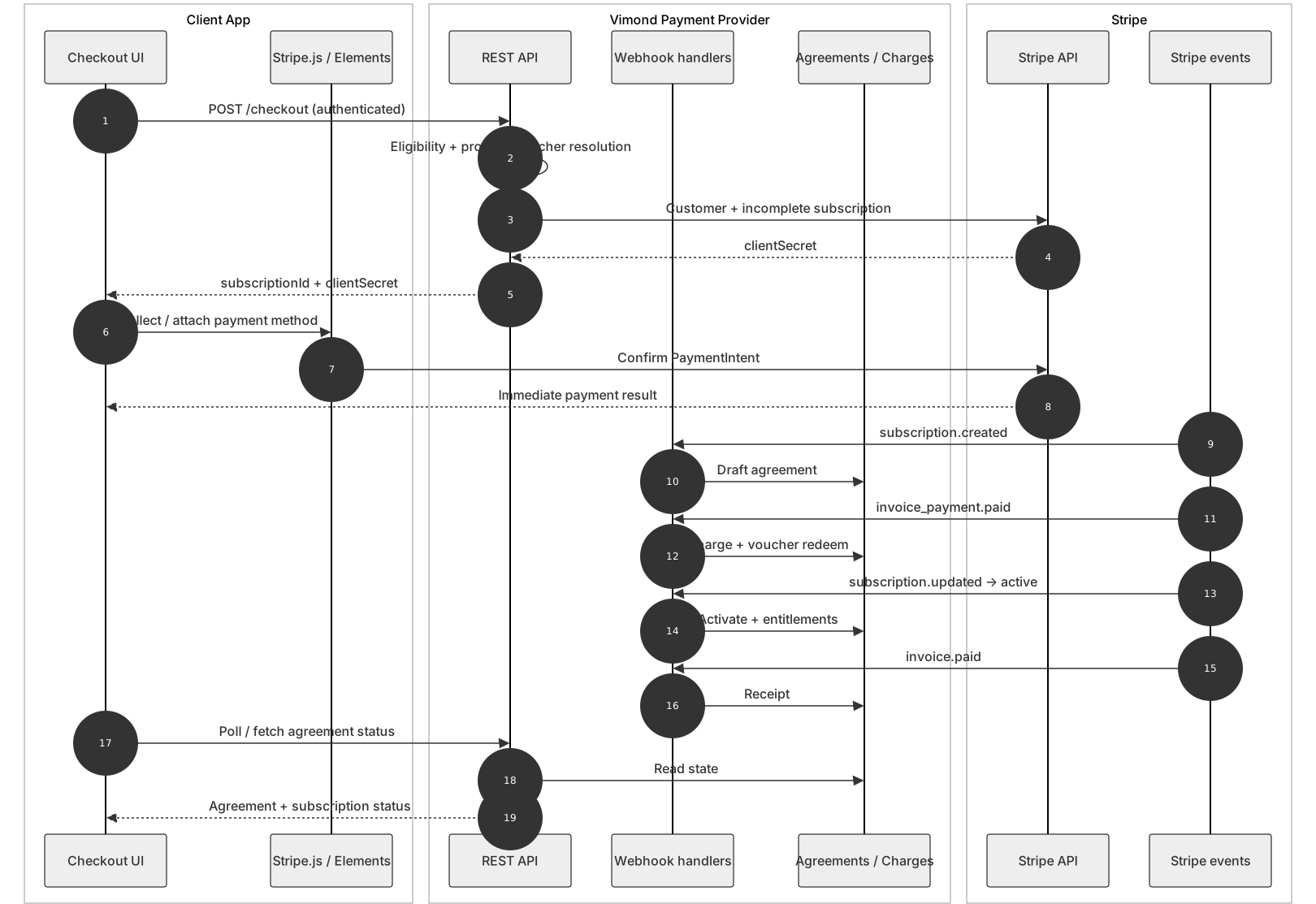
Stripe SVOD subscription state machine
Section titled “Stripe SVOD subscription state machine”
Webhook events with dedicated handlers
Section titled “Webhook events with dedicated handlers”| Stripe event | Handler | Main effect |
|---|---|---|
customer.subscription.created | StripeSubscriptionCreatedHandler | Draft agreement |
invoice_payment.paid | StripeInvoicePaymentPaidHandler | Persist charge; redeem voucher on first charge |
customer.subscription.updated | StripeSubscriptionUpdatedHandler | Route by status strategy |
invoice.paid | StripeInvoicePaidHandler | SVOD receipt |
customer.subscription.deleted | StripeSubscriptionDeletedHandler | End agreement, release voucher if needed |
StripeEventType also lists charge, payment_intent, checkout.session, and invoice failure events — some are observability-only or TVOD-specific.
Webhook entry points:
POST /api/v1/webhook/stripe/— shared tenant mode (preferred; resolves tenancy from Stripe account)POST /api/v1/webhook/stripe/{organization}— organization-scoped variant
All Stripe webhooks require a valid Stripe-Signature header.
Key backend endpoints
Section titled “Key backend endpoints”| Endpoint | Purpose |
|---|---|
POST /api/v1/pay/stripe/checkout | Create SVOD subscription; returns clientSecret |
POST /api/v1/pay/stripe/tvod | Create TVOD payment intent |
GET /api/v1/customer/paymentMethods | List saved payment methods |
PUT /api/v1/customer | Update customer / default payment method |
POST /api/v1/webhook/stripe/ | Stripe webhook receiver |
Key frontend interactions
Section titled “Key frontend interactions”- Fetch methods:
getCustomerPaymentMethods(...) - Checkout calls:
createStripeSubscription(...),createStripeTVOD(...) - Payment confirmation:
stripe.confirmCardPayment(...)
- Backend is the source of truth for final state via Stripe webhooks.
- Frontend handles immediate UX, but webhook processing finalizes durable agreement and charge state.
Related guides
Section titled “Related guides”- Payment — product groups, orders, and REST API purchase flow
- SVOD — viewing and managing subscriptions after purchase
- TVOD — transactional purchases
- Auto-renew subscriptions — renewal behaviour